
By Heritage Craft Center ·
God Ganesh Statue Guide: How Handmade Metal Ganesh Figures Are Made, Read, and Chosen in Bhaktapur
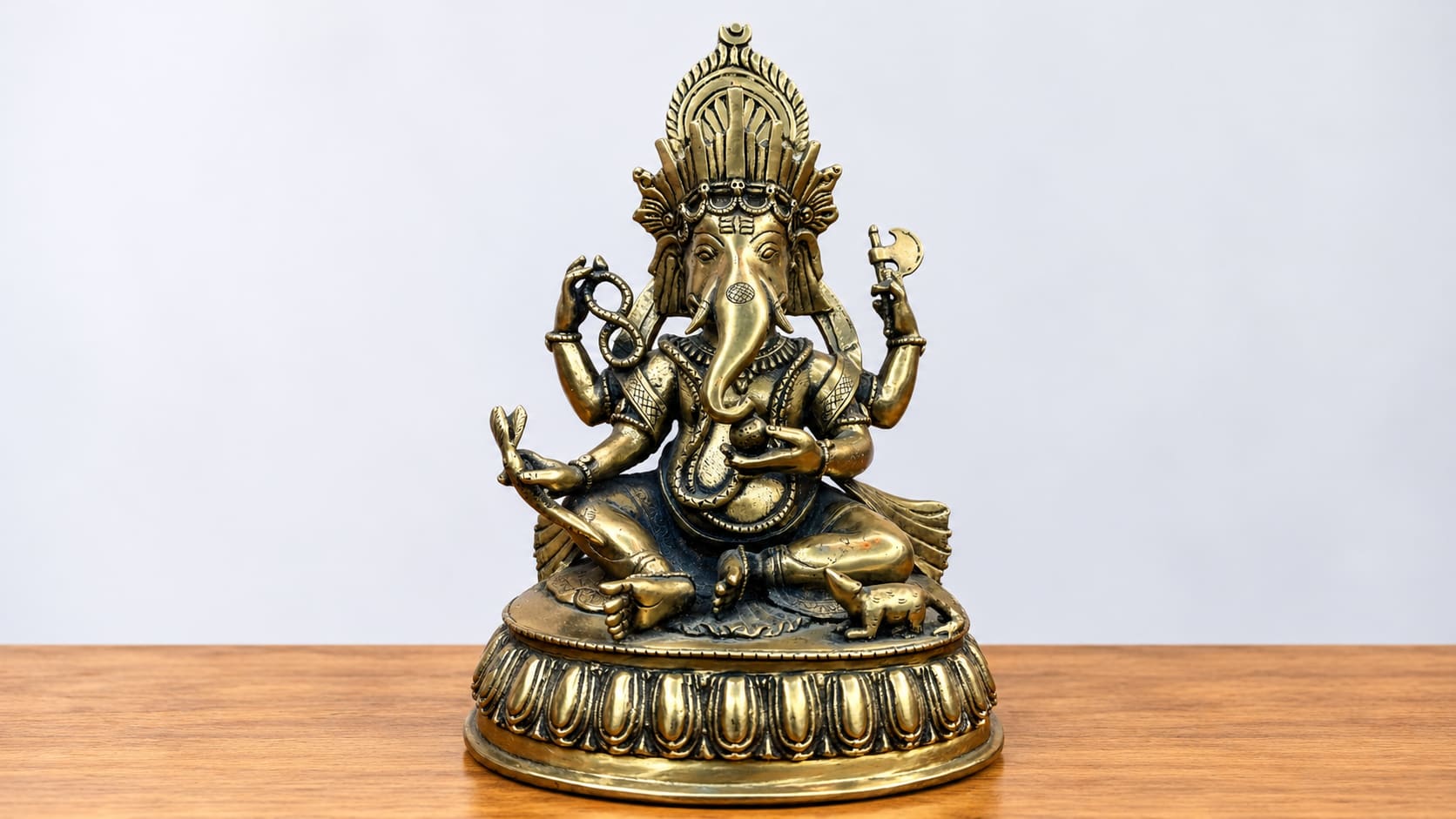
Why the God Ganesh Statue Holds Such a Central Place in Nepali Homes and Shrines
A God Ganesh statue is often the first deity image a family places in a new home, shop, or study in Nepal. Ganesh is the remover of obstacles and the lord of beginnings, which is why a God Ganesh statue is often chosen as a home decor piece or a gift for a new venture. His name, Vighneshvara or Vighnaharta, means the lord or remover of obstacles.
Because of this role, he is invoked before other deities. In Hindu households a prayer to Ganesh opens a puja, a wedding, a business venture, or the writing of a new book. Newar families in the Kathmandu Valley follow the same order, and Ganesh shrines stand at crossroads, courtyards, and city gates. In Bhaktapur, the Suryabinayak temple on the edge of the city is a well-known Ganesh shrine.
Where a metal Ganesh sits
A metal figure usually sits in one of three places. The first is the home altar, where it stands with other deities and receives daily offerings such as a flower, a dab of tika powder, or a small lamp. The second is the entrance of a shop or office, where it faces customers and is meant to guard the start of each working day, while a small figure on an office desk serves the same purpose at a personal level. The third is a study desk, where it is a quiet reminder before exams or new projects.
Placement follows ritual. A figure on an altar is treated as an image to be greeted each morning. A figure at a doorway is more often a mark of blessing than an object of daily worship. Many families keep the image at a raised level and never on the floor, out of respect.
Ganesh also appears on metal lamps. The Newar sukunda oil lamp often carries a Ganesh panel above the wick dish, as in this sukunda. Our guide to the Nepali oil lamp tradition explains these lamps in more detail.
Devotional or decorative
It helps to decide early whether you want a devotional figure or a display piece. A devotional figure is made to follow the established iconography, because it will be bathed, offered to, and prayed before. A decorative piece may take freer liberties with pose, proportion, or finish.
Neither choice is wrong. But a buyer who plans daily worship should check the details in the next section, and a buyer who wants a shelf object can focus more on finish and scale. Telling the seller your purpose makes it easier to choose well.
Reading the Symbolism in a God Ganesh Statue: Trunk, Tusk, Mouse, and Hand Positions
Almost every part of a Ganesh figure carries meaning. Knowing what to look for helps you judge whether a piece was made by someone who understands the tradition.
Trunk direction
The trunk usually curls toward one side. A trunk curling to the left, the figure's own left, is the most common form. Some practitioners link it with calm, household life, and domestic worship.
A trunk curling to the right is rarer. In some traditions it is said to require stricter and more regular ritual care, and it is more often seen in temples. Practices differ between families and regions, so treat this as a common teaching and not a universal rule. If it matters to your household, ask your own priest or elders.
The tusk, the modak, and the mouse
Ganesh is shown with one tusk broken. Several stories explain it. The best known says he broke it off to use as a pen when he wrote down the Mahabharata as the sage Vyasa recited it, which stands for sacrifice made in the service of learning.
The modak is a sweet dumpling, often held in one hand or placed near the trunk tip. It stands for the reward of spiritual effort and is also Ganesh's favourite offering. The mouse, called Mushika, is his vahana, or vehicle. It is usually shown at his feet, often looking up at the sweet. Many readers take the mouse as the restless mind, kept steady by the god who rides it.
The Ganesh at the top of this page shows these details clearly: the trunk, a sweet held near it, and the mouse at his feet on the lotus base.
Hands and gestures
Most figures have four arms, though two, six, and more appear, and the color and finish of the metal can also vary by piece. Common objects in the hands include the axe (parashu), the goad (ankusha), the noose (pasha), a lotus, a broken tusk, and the modak.
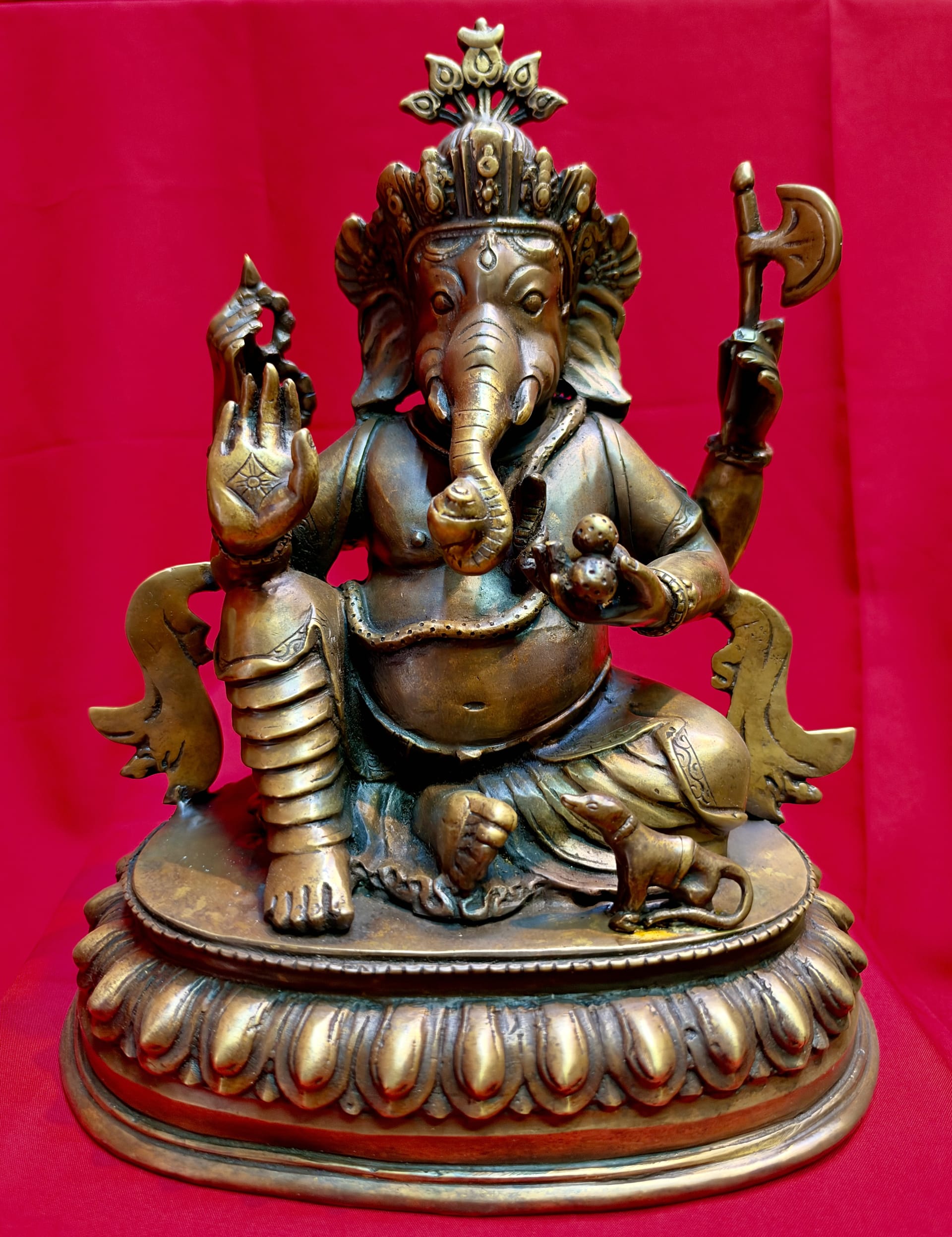
See this piece: Seated Ganesh with Axe.
Two gestures appear often. The same gestures are seen on Buddha figures, as our guide to Buddha mudras explains.
- Abhaya mudra: the palm is raised and faces outward. It means "do not fear" and offers protection.
- Varada mudra: the palm faces down or outward with fingers extended. It means a boon is being granted.
Checking that the iconography is consistent
Before buying, look over the figure as you would read a page. A consistent piece usually passes these checks:
- The head is an elephant's, with one tusk whole and one broken or shortened.
- The trunk curls in one clear direction, and it is the direction you intended.
- The mouse is present and in proportion, not larger than the hand or sweet.
- The hands hold recognisable attributes, or form a clear mudra.
- The seating posture is stable, often on a lotus base or a low seat, with a rounded belly.
Seated figures are the most common, but standing and dancing forms are also traditional. Nritya Ganesh, the dancing Ganesh, stands on one leg with the other raised, and is often seen in the Kathmandu Valley.
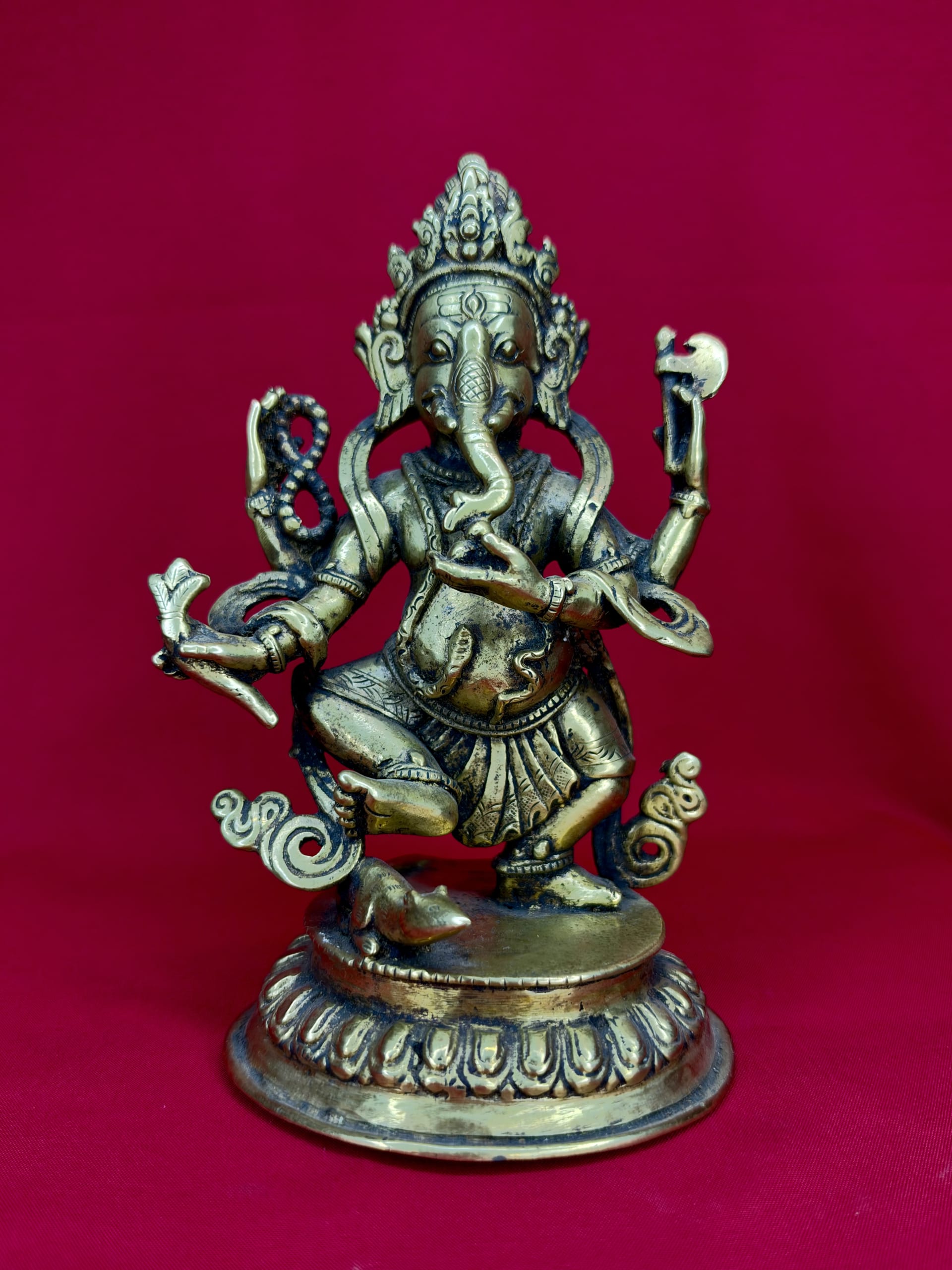
See this piece: Nritya Ganesh (Dancing Ganesh).
A figure with two whole tusks, a missing mouse, or hands holding unrelated objects may be a loose decorative interpretation. That is fine for display, but you should know it before you pay.
How Lost-Wax Casting Produces a Solid Metal Ganesh Statue
Lost-wax casting, or cire perdue, is the main method for making detailed metal deities in the Kathmandu Valley. Patan is the best-known centre, though the technique is shared across the valley's metalworking towns. The name comes from the fact that the wax model is lost during the process. That means each mould is used once.
The process in order
- Sculpting the wax model. The maker shapes the whole figure in wax, usually a blend of beeswax and resin. Crown, jewelry, folds of cloth, and facial features are all modelled here, so the wax is where the artistry happens.
- Coating in clay. The wax is covered in layers of fine clay, with coarser clay added over it to form a strong shell. Small channels are left for the metal to enter and for air to escape.
- Melting out the wax. The dried mould is heated and the wax runs out, leaving a hollow in the exact shape of the figure.
- Pouring the molten metal. Brass or bronze is melted and poured into the hot mould. It fills every thin space the wax once held.
- Breaking away the mould. After the metal cools, the clay shell is broken off, revealing the rough casting.
Because the mould is destroyed, no two cast pieces are exactly alike, even when made from the same pattern. Some makers pour solid metal for small and medium figures. Larger figures are sometimes cast hollow around a clay core, so it is worth asking which you are buying.
Why fine detail survives
Wax records detail very well. Fine lines in a crown, the beads of a necklace, or the curl of a trunk tip can all be modelled in wax and then picked up by the clay. When the molten metal replaces the wax, it takes on the same detail.
Other casting methods that use sand moulds or two-part moulds struggle with undercuts, such as a hand held away from the body or an ornament that curves back. Lost-wax handles those shapes in a single pour.
Finishing after casting
Casting gives a rough form. The work that follows is what makes it a finished figure:
- Removing the channels where metal entered and filing the seams.
- Chasing, which means cutting and sharpening details by hand with small chisels and punches.
- Polishing the surface to a bright finish, or applying a patina for a darker, aged look.
A well-finished piece shows the maker's hand even in these last steps. Edges around the eyes, fingers, and ornaments should look deliberate and clean.
Repoussé and Engraving: Adding Surface Detail to a God Ganesh Statue
Casting is not the only way to make or decorate a God Ganesh statue. Two other hand techniques are used in Nepali metalwork, often on the same piece. Understanding them helps you see how a figure was really made.
Repoussé
Repoussé is the art of raising a design by hammering a metal sheet from the back. The sheet is usually set on a bed of pitch or lac, which supports the metal while it is worked. The craftsman pushes the design outward with punches and hammers, then turns the sheet over to refine it from the front, a stage called chasing.
A craftsman chooses repoussé over casting when the form is large but light, such as a plaque, a halo, a crown, or a large figure built in sections. Repoussé figures are hollow and thin-walled by nature. Casting is chosen when the figure needs weight, rounded volume, and fine three-dimensional detail.
Engraving
Engraving removes metal. The craftsman cuts lines with chisels or gravers, and the metal's thickness stays the same. Engraving is used for patterns on borders, clothing designs, inscriptions, and fine lines that need to stay crisp.
Compared with repoussé, engraving gives a flat, sharp line and no raised relief. Repoussé gives depth and shadow. Both take time. Fine engraving over a whole surface demands patience and a steady hand, and repoussé in a large sheet takes strength and many passes. Neither is quick, which is why hand-tooled pieces cost more labor than stamped ones.
Spotting hand-tooled work
Machine stamping presses a design into metal with a die. It can look convincing in photos, but a few signs usually give it away:
- Repeated identical patterns. On hand-worked pieces, a repeating flower or bead differs slightly each time. On stamped pieces the repeats match perfectly.
- Tool marks. Hand chisels leave small overlapping strokes and slight irregularities. Stamped pieces look uniform and flat.
- Edges. Hand-finished edges feel softened and slightly rounded. Machine edges are often sharp or have burrs.
- The back. Repoussé work shows the raised design as a hollow on the reverse. A stamped piece may have a flat or inconsistent back.
None of this means every irregularity is a virtue. Rough, careless finishing is still poor work. The aim is clean craftsmanship that still shows a human hand.
Choosing Brass, Bronze, or Copper for a God Ganesh Statue
The metal you choose affects the figure's colour, weight, upkeep, and how it ages on a shrine.
How the three compare
- Brass is copper mixed with zinc. It has a warm golden-yellow colour, takes a bright polish, and is the most common metal for household figures. It tarnishes moderately, and the tarnish is easy to manage.
- Bronze is copper mixed with tin. It is darker and more brown or reddish-gold, and it tends to be harder. Over time it develops a deep, even patina that many collectors prefer to a bright shine.
- Copper is the pure metal. It is reddish, softer, and darkens faster, turning brown and sometimes green with exposure. Copper is widely used in ritual vessels, and some households prefer it for that reason.
In everyday trade, the words brass and bronze are sometimes used loosely. If the alloy matters to you, ask the seller what it actually contains.
Alloy, sound, and weight
Alloy content changes how a metal rings when tapped. Bell bronze, which has a high tin content, produces a clear, sustained tone, which is why bells and singing bowls use it. Brass gives a duller sound. This is a handy test for statues too: a solid cast figure gives a short, dense, muted tap, while a thin hollow shell may ring or sound tinny.
Brass, bronze, and copper are close in density, so the metal alone does not explain a big difference in weight. A heavy figure relative to its size is a good sign of solid casting. A surprisingly light figure may be hollow, thin-walled, or made from sheet. Hollow is not bad when it is declared, but it should not be sold as solid.
Matching height to the space
Measure the shelf or altar before you choose. Leave clear space around the figure, ideally at least a hand's width above the crown and room on each side for a lamp or small offering dish. The base should sit fully on the surface with no overhang.
As a rough guide, small figures of a few centimetres suit a desk or a compact home altar. Medium figures suit a shrine shelf or a living room niche. Larger figures need a sturdy surface that can carry their weight. Check that your shelf can handle it, because a solid brass figure is heavier than it looks.
Buying a Handmade God Ganesh Statue: Questions to Ask Before You Pay
Buying metalwork is easy when you ask clear questions. A good seller will answer them plainly and without hurry.
Questions to ask the seller
- Where was it made? Ask where the piece was cast or hammered, and whether it was made by hand or by machine.
- What is the alloy? Ask whether it is brass, bronze, or copper, and whether it is plated or coated.
- Is it solid or hollow? Ask if the figure is solid cast, hollow cast, or built from sheet.
- What are the final dimensions and weight? Ask for height, width, and depth in centimetres, plus weight in grams or kilograms. Weight is a strong clue to solidity.
- What is the finish? Ask whether it is polished, patinated, lacquered, or gilded. A lacquered piece needs different care.
Asking for more photographs
Listing photos usually show the front of the figure in good light. Before you commit, request more:
- The base. It shows whether the figure is solid or hollow and whether there is a closing plate.
- The back. It shows the quality of finishing, seams, and tool marks.
- Close-ups of the face, hands, and ornaments. They show how clean the chasing is.
- Any engraved marks. These might be inscriptions or maker's marks.
- A photo with a ruler or a hand for scale.
A short video turning the figure in daylight is even better. A seller who happily sends these is usually one who stands behind the piece.
Caring for a Brass or Bronze God Ganesh Statue at Home
Metal figures are durable, but how you clean and keep them decides how they look in ten years.
Safe cleaning
For regular cleaning, use a soft dry cloth to remove dust. When the surface needs more, use a soft cloth with lukewarm water and a little mild soap. Wipe gently, rinse with a damp cloth, and dry immediately with a clean towel. Water left in recesses causes spotting.
Avoid harsh chemicals. Metal dips, strong acids, bleach, and abrasive scouring pads strip the patina and can scratch the surface. Traditional home cleaners such as lemon, tamarind, or ash do work on brass, but they also remove the darker tones in the details. Test any method on a hidden spot first.
If the figure is lacquered, wipe it only with a damp cloth. Polish would damage the coating.
Offerings need attention too. Remove flowers, oil, ghee, and red powder regularly. Oil left on the surface turns sticky and collects dust.
Tarnish and patina
Brass and bronze darken with time as they react with air and skin oils. A bright polish is one choice, but it is not always the best one.
Leave natural darkening in place when it sits in the recesses, such as around the crown, folds of cloth, and ornaments. That contrast makes details easier to read and gives an older look. Some figures are given a dark finish from the start, so the whole surface has this deeper tone. Polish only when tarnish is uneven, spotty, or hides detail. Use a soft cloth and a gentle metal polish, and polish raised areas lightly so the darker recesses remain.
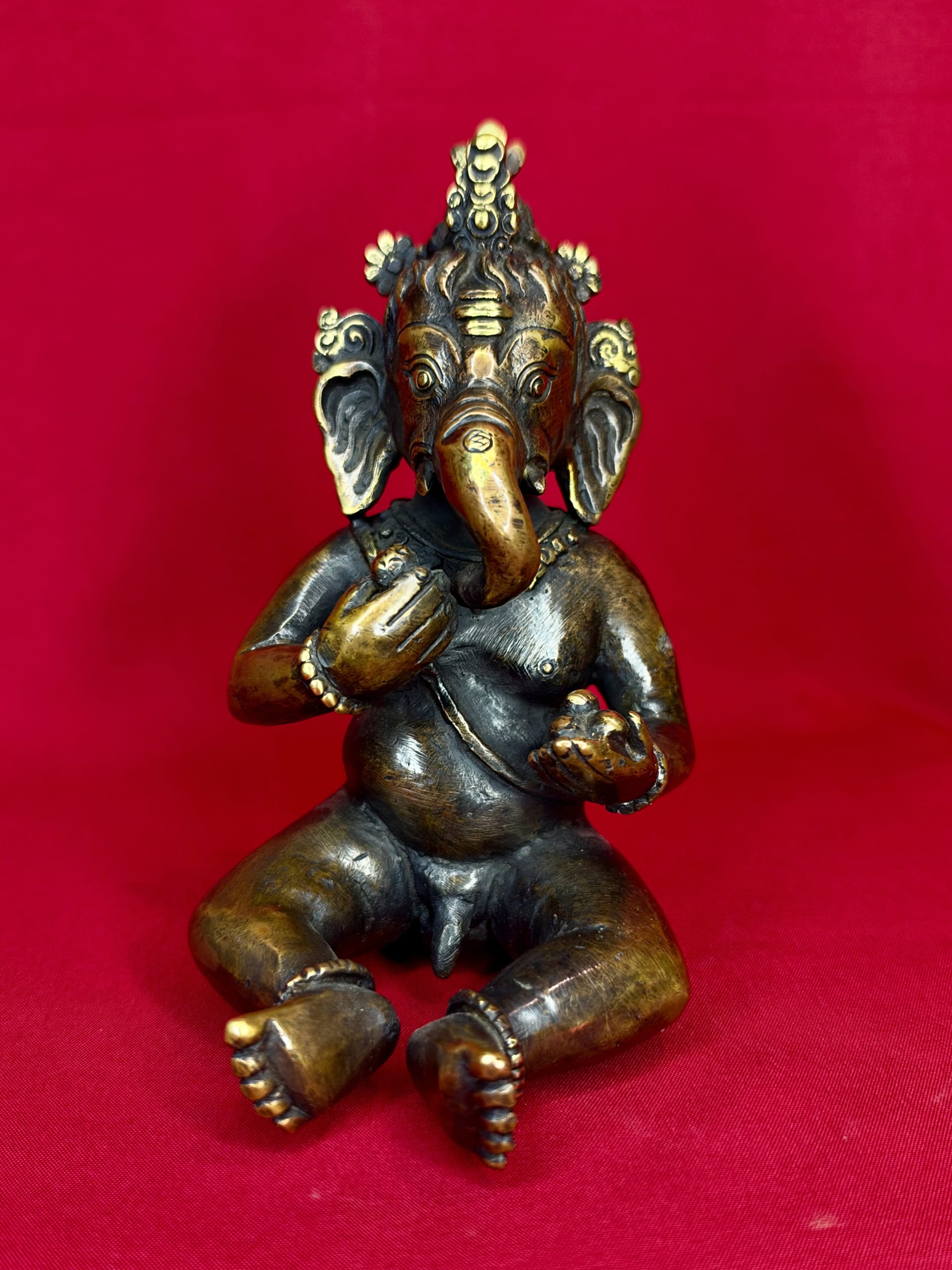
See this piece: Bal Ganesh (Child Ganesh).
A thin coat of microcrystalline wax can slow future tarnishing on a polished piece, though it is optional.
Storage and placement
- Keep the figure away from humidity. Damp air speeds up tarnish and can cause green spots on copper alloys.
- Keep it away from direct heat, such as radiators and strong sunlight through glass.
- Avoid placing it in kitchens, where steam and cooking vapor leave a film.
- If you store it, wrap it in a soft cotton cloth and not in plastic, which can trap moisture.
Where to See God Ganesh Statues in Bhaktapur, and How to Ask About a Piece
Heritage Craft Center is a metalcraft shop at Dattatraya Square in Bhaktapur, one of the old cities of the Kathmandu Valley and long known for its metalwork, woodcarving, and pottery. The shop has been open for more than 20 years. Its collection is curated, with singing bowls, statues, bells, lamps, and ritual objects chosen one at a time for material, finish, and detail.
Metal figures, including God Ganesh statues, are displayed in the shop for visitors to see in person. Holding a piece lets you judge its weight, check the finish, and look closely at the face and hands. That is the best way to apply what this guide describes.
You can browse the current Ganesh statues and other metal statues on the website. Since the collection is chosen piece by piece, what is available can change.
Prices are given on request. To ask about any piece, message us on WhatsApp or contact the shop. Tell us what you want to know: the material, the finish, the size, or the weight. If you cannot visit, ask for extra photographs of the base and back, and tell us whether you want a devotional figure or a decorative one. We are glad to answer before you decide.
FAQ
Which way should the trunk of a Ganesh statue curl?
A trunk curling to the figure's own left is the most common form and is widely chosen for homes. A trunk curling to the right is rarer, and in some traditions it is said to need stricter ritual care. Practices differ between families, so ask your own priest or elders if it matters to you.
Where should I place a Ganesh statue at home?
Common places are the home altar, the entrance of a shop or office, and a study desk. Keep the figure at a raised level and never on the floor. Leave space around it for a lamp or a small offering dish.
How can I tell if a metal Ganesh statue is solid or hollow?
A solid cast figure feels heavy for its size and gives a short, dense tap. A hollow or sheet-built figure is lighter and may ring or sound tinny. A photo of the base also shows whether it is solid or closed with a plate.
Is brass or bronze better for a Ganesh statue?
Neither is better. Brass has a warm golden colour and takes a bright polish. Bronze is darker and harder, and it develops a deep, even patina over time. If the alloy matters to you, ask the seller what the piece contains.
How do I clean a brass Ganesh statue?
Dust it with a soft dry cloth. When it needs more, wipe it with lukewarm water and a little mild soap, then dry it straight away. Avoid acids, metal dips, and scouring pads, and leave the darker tone in the recesses so the details stay easy to read.
Key Takeaways
- Ganesh is invoked first as the remover of obstacles, so a metal figure often marks a beginning: a new home, a shop, or a course of study.
- Read the trunk, tusk, mouse, and hands to check that a figure follows the traditional iconography.
- Lost-wax casting records fine detail, and because each mould is broken, no two cast pieces are exactly alike.
- Before buying, ask about the alloy, whether the figure is solid or hollow, its size and weight, and its finish.
- Clean gently with a soft cloth and mild soap, and leave the darker tone in the recesses.