
By Heritage Craft Center ·
Green Tara Bodhisattva: Meaning, Iconography, Mantra, and How to Choose an Authentic Statue
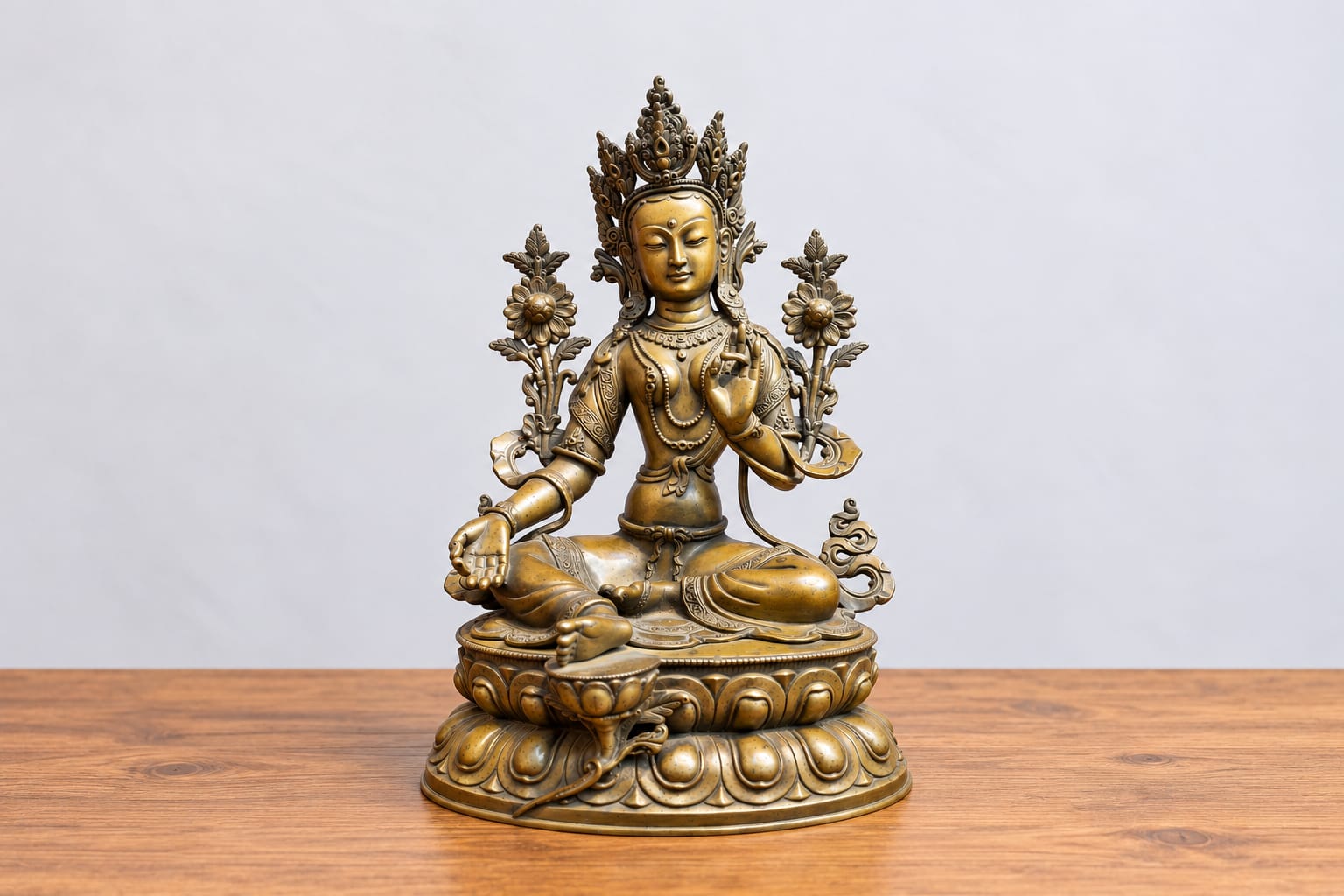
The Green Tara Bodhisattva is one of the most loved figures in Tibetan and Nepalese Buddhism. She is a female bodhisattva known for compassion and for quick, practical help. Her image appears on altars, thangka paintings, and metal statues across the Himalayan region.
Who Is the Green Tara Bodhisattva in Tibetan and Nepalese Buddhism
Tara is a female bodhisattva. A bodhisattva is a being who has committed to full awakening in order to free others from suffering. Green Tara is the form most associated with swift action, protection, and compassion in motion.
In popular writing, Tara is sometimes described as a Buddhist goddess. In Buddhist teaching, though, she is a bodhisattva, not a creator god or a supreme ruler. She is revered as an enlightened or awakened being who helps others overcome suffering.
Her name, Tārā, means 'star' in Sanskrit and is traditionally associated with the idea of crossing over. In Buddhist teachings, she is understood as the liberator who helps beings cross the ocean of suffering. In Tibetan, she is called Drolma, meaning 'the one who liberates.'
Traditional origin stories
The best-known account links her to Avalokiteshvara, the bodhisattva of compassion. He looked over the world and wept at how much suffering there was. In one version, Tara was born from a tear. In another, the tears formed a lake, and a lotus rose from it with Tara inside.
Some tellings say two tears formed two Taras, one green and one white. These are traditional narratives, and they vary between lineages and texts. They are best read as teaching stories about where compassion comes from, not as history.
Tibetan Buddhist tradition also associates Tara with royal history. The Nepalese princess Bhrikuti, traditionally said to have married the Tibetan king Songtsen Gampo, is commonly regarded as an emanation of Green Tara. Although this is a traditional religious association rather than an established historical fact, it connects Nepalese Buddhist heritage with the development of Tibetan Buddhism.
Why "Green Tara Buddha" is a misunderstanding
People often search for "Green Tara Buddha." The phrase is common, but it blurs two things. "The Buddha" usually means Shakyamuni, the historical teacher who lived in northern India about 2,500 years ago. Green Tara is a separate figure, honored in later Mahayana and Vajrayana traditions.
There is a nuance. Some Vajrayana teachers say Tara is a fully awakened buddha who appears in bodhisattva form to help beings. In everyday usage and in art, she is still called a bodhisattva, and she is not the historical Buddha.
Green Tara Buddhism: Practice, Lineages, and Devotion
In Green Tara Buddhism, devotion and meditation go together. In Tibetan Buddhism she is a central figure in Vajrayana, the tantric path. Practitioners do not only pray to her. They also visualize her in detail and learn to see her qualities as their own potential.
A typical practice has a few parts:
- Taking refuge and generating the wish to benefit all beings.
- Visualizing Tara in front of oneself, in green light, seated on a lotus.
- Reciting her mantra while imagining light radiating from her heart.
- Dedicating the merit to others.
Her best-known liturgy is the Praise to the Twenty-One Taras. It describes twenty-one forms of Tara, each with a verse of homage. The prayer is widely recited in Tibetan Buddhist communities, both as a daily devotional practice and on special occasions.
Swift help and the larger path
Green Tara is invoked when people feel fear or urgency. Traditional texts speak of protection from eight dangers, such as lions, fire, water, and thieves. Teachers often read these as outer dangers and also as inner ones, such as pride, anger, and doubt.
This matters because the practice is not a transaction. Asking for help is one side of it. The deeper aim, shared by all Buddhist schools, is to develop compassion and wisdom. Tara's swiftness is understood as the quickness with which a trained mind responds to suffering.
Tara devotion in the Kathmandu Valley
Newar Buddhist communities in the Kathmandu Valley have maintained traditions of Tara worship for generations. Green Tara, White Tara, and other forms appear in devotional practices, shrines, and ritual traditions. The valley's longstanding metalworking heritage has also contributed to the creation of Buddhist devotional sculptures.
Iconography of Green Tara: Posture, Hands, and Symbols
Statues and paintings of Tara follow rules that are written down in texts and passed between artists. Because of this, a Green Tara statue can be read like a diagram. Each detail points to a quality.
Posture and appearance
Green Tara is most often shown seated, with her right leg extended and her left leg folded. The extended leg shows readiness to rise and act. The folded leg shows steady meditation. Together they express wisdom and compassionate action held in balance.
She can also be shown standing, which is less common but not unusual in Nepalese metalwork. A standing figure carries the same idea of readiness. Whatever the posture, the image has these traits:
- A green complexion, which in Buddhist color symbolism is linked with enlightened activity.
- A youthful, calm face with a gentle expression.
- A crown, earrings, necklaces, bracelets, and anklets, since she is shown as a bodhisattva in princely dress.
- A lotus seat, often with a moon disc.

See this piece: Standing Green Tara.
The hands and the utpala
Her right hand rests on the right knee in varada mudra, explained further in our guide to Buddha mudras, the gesture of giving or granting boons. The palm faces outward and the fingers point down. It says that help is offered.
Her left hand is held near the heart in a gesture associated with blessing and protection. It holds the stem of an utpala, a blue lotus that rises beside her shoulder. In some images a second utpala rises on the right side.
The utpala is commonly explained as a symbol of purity and of the active, compassionate mind.
The statue on the cover of this page shows all of these details: the right foot stepping down onto a small lotus, the right hand in varada mudra, and an utpala rising at each shoulder. See this piece: Seated Green Tara Statue.
Green and White Tara in the image
When you place the two side by side, the differences are easy to see. Green Tara is commonly represented with one leg extended, symbolizing readiness for compassionate action. White Tara is generally depicted seated in vajra posture and is distinguished by her seven eyes. These are common iconographic conventions, although artistic representations can vary across traditions and historical periods. The next section sets these out in more detail.
Green Tara and White Tara: How to Tell Them Apart
Green Tara and White Tara are the two most common Tara forms, and buyers often confuse them. Both are Tara, and both are linked to compassion. They differ in color, posture, and emphasis.
Complexion, eyes, and emphasis
Green Tara is green. She is associated with swift action and protection from fear and danger. White Tara is white, like the moon, and is associated with long life, healing, and serenity.
White Tara is also called the Wish-Fulfilling Wheel (Cintachakra) or the Tara of Seven Eyes. Besides the two eyes in her face, she has an eye in each palm, an eye on each sole, and a third eye on her forehead. This seven-eye motif is a clear marker. It shows her watching over all beings with compassion.
Green Tara normally has the usual two eyes, plus sometimes a third eye on the forehead. She does not have eyes on her palms and soles.
Why both appear on one altar
Both are said to be emanations of Avalokiteshvara's compassion. Practitioners often keep both because they speak to different needs. Green Tara is turned to when something needs to be done quickly. White Tara is turned to for health, longevity, and a calm mind.
Many families also keep an image of the Twenty-One Taras, where each has her own color and attribute. For beginners, a Green Tara and a White Tara together make a simple, balanced pair.
Practical visual checks
When you look at a statue, check these points in order:
- Color. Is the figure green, white, or unpainted metal? Metal statues are not always colored, so use the other points as well.
- Seat. Is one leg extended, or are both legs crossed in full lotus?
- Palms and soles. Look for small eyes. If they are present, it is White Tara.
- Right hand. A hand resting on the knee, palm out, is varada mudra.
- Flower. Both forms hold an utpala, so use it together with the seat and the eyes.
If a statue shows mixed features, ask the seller to explain which form it represents. A seller who knows the tradition will answer directly.
The Green Tara Mantra and How It Is Recited
The Green Tara mantra is:
OM TARE TUTTARE TURE SOHA
In Sanskrit the last word is written svaha, and Tibetans pronounce it "soha." The mantra is short and widely recited by monks, nuns, and lay people.
What the syllables mean
Different Tibetan Buddhist teachers interpret the mantra in slightly different ways. The following is a commonly taught symbolic explanation rather than a word-for-word translation.
- OM is the opening syllable. It stands for the body, speech, and mind of the awakened ones.
- TARE calls on Tara as the one who liberates from suffering and from the cycle of rebirth.
- TUTTARE is taken to mean freeing from the eight fears or dangers.
- TURE is read as granting true freedom, including freedom from inner afflictions and sickness.
- SOHA means roughly "so be it," a way of sealing the prayer so the meaning takes root.
Interpretations of the mantra vary between teachers and lineages. Its syllables are generally understood through their symbolic associations with liberation, protection, and the overcoming of suffering.
How practitioners recite it
Most people count repetitions with a mala, a string of 108 beads, though some use 21 or 27 for shorter sessions. The count of 21 echoes the Twenty-One Taras. Others recite silently while walking or working, or aloud as part of a longer practice.
In a formal session, the mantra is said while visualizing green light from Tara's heart filling the practitioner and all beings. Traditionally, a qualified teacher is recommended. A teacher can explain the visualization, correct pronunciation, and give context so the practice does not stay on the surface.
Devotion versus empowerment
Reciting the mantra as an act of devotion is permitted in many Tibetan Buddhist traditions without formal empowerment. However, requirements vary between lineages. Formal empowerment, called wang in Tibetan, is generally required for certain full Vajrayana sadhana practices. If you intend to undertake formal practice, consult a qualified teacher in your lineage.
Choosing an Authentic Green Tara Statue
A Green Tara statue can be a devotional object for an altar or a collectible piece of Himalayan art. Either way, the question is the same: how was it made, and by whom?
How handmade statues are made
Many Nepalese statues are made by lost-wax casting. The artisan sculpts the figure in wax, covers it in clay, and heats it so the wax runs out. Molten metal is then poured into the hollow. Once cooled, the clay is broken away.
After casting, the work is only half done. The artisan files and chases the surface, which means cutting fine lines for jewelry, hair, and the folds of cloth. Some pieces are gilded or have the face painted by hand. Larger forms and some details can also be built up by hand-hammering, or by repoussé, in which sheet metal is shaped from behind.
Certain craftsmanship details can help you assess the quality of a statue, although they do not independently establish its authenticity or prove that it was handmade. Pay particular attention to the face, hands, jewelry, decorative details, and base:
- Face. Look for clearly defined facial features, carefully finished eyes, brows, and lips, and balanced proportions. The quality of facial detailing can help you assess the artisan's workmanship.
- Hands. Clear fingers with natural proportions, and a visible utpala stem with an attached flower.
- Jewelry and cloth. Examine the jewelry and clothing for clearly defined engraved or chased details. Well-finished work should have clean, legible patterns and carefully shaped decorative elements.
- Base. Examine the lotus base for carefully shaped petals and a well-finished surface. Some traditional statues have a sealed base plate, occasionally marked with a crossed vajra, although this feature is not universal.
Handcrafted statues may show subtle variations in surface finishing, facial detailing, engraving, and decorative elements. However, these characteristics alone cannot establish authenticity or prove that a statue was handmade. Ask the seller about the artisan, workshop, manufacturing process, materials, and origin of the piece. Detailed photographs of the face, hands, ornaments, and underside can help you assess its craftsmanship.
Questions to ask a seller
Before you buy, ask:
- What is the material: brass, copper, bronze, or another alloy?
- Where was it made, and by whom or which workshop?
- What are the height, width, and weight?
- Is the finish gilded, painted, oxidized, or plain? Is it hand-finished?
- Is the base sealed or open?
- Can you share clear photos from several angles, and a short video?
Each piece on our site has photos and, where measured, its height and weight. Ask us on WhatsApp about the material, finish, and price.
Placement and respect
Decide how you will use the statue before buying. A devotional piece needs a clean, raised place. A collectible piece needs a stable shelf or display. Either way, treat it with care and keep it away from floors, shoe racks, and bathrooms.
At Heritage Craft Center, we offer three Tara pieces on our site: a Seated Green Tara Statue, a Standing Green Tara, and a Tara Butter Lamp. The seated statue shows her in the classic pose with one foot stepping down. The standing statue shows her in the readiness of a standing posture. The butter lamp holds a flame as an offering.
To ask about the Seated Green Tara, the Standing Green Tara, or the Tara Butter Lamp, message us on WhatsApp. We will answer questions about the material, finish, size, and price, and we can tell you about other Tara pieces in the shop.
Caring for a Green Tara Statue and Shrine Objects at Home
Brass and bronze last a long time if they are treated gently. Most damage comes from overcleaning and from rough handling.
Cleaning
Dry dusting is usually enough. Use a soft cloth or a soft brush, and work along the details instead of across them. For fingerprints, a clean, dry cotton cloth works well.
Avoid harsh chemicals. Strong metal polishes, acids, and abrasive pastes can strip the patina, the darkened layer that gives older metal its depth. They can also damage gilding and cold paint. Keep water away from painted faces.
If a piece needs deeper cleaning, ask the seller first. Different finishes call for different treatment.
Placement and offerings
For a devotional statue, choose a clean, stable, and elevated location, such as a dedicated altar or shrine. Many Buddhist households place statues and images above ordinary household objects and away from areas associated with footwear or waste. Specific customs can vary by family, teacher, and tradition.
If you use a butter lamp, such as the Tara Butter Lamp, keep it on a stable, heatproof dish. Use a cotton wick and clarified butter or a vegetable oil. Trim the wick, keep the flame away from curtains and paper, and never leave it burning unattended. Wipe away soot and drips once the lamp has cooled. Our butter lamp guide covers fuel and care in more detail.
Other offerings, such as water bowls, are changed daily in many traditions. Empty and dry the bowls at night so they do not stain the surface.
Storage and travel
When you move or travel, wrap the statue in soft cloth or acid-free tissue first. Plastic bubble wrap should not touch gilding or paint directly. Pad the lotus petals, the hands, and the utpala, which are the parts most likely to bend or snap.
Put the wrapped statue in a snug box and fill the empty space so it cannot shift. Place that box inside a second, larger box with padding between them. Label it as fragile and keep the original packaging for later.
FAQ
Is Green Tara a Buddha or a bodhisattva?
She is most commonly described as a bodhisattva. The Buddha, in the usual sense, is Shakyamuni, the historical teacher. Some Vajrayana teachers say Tara is a fully awakened buddha who appears in bodhisattva form, but she is a different figure from the historical Buddha.
What is the difference between Green Tara and White Tara?
Green Tara is green, is commonly shown with one leg extended, and is associated with swift action and protection. White Tara is white, is generally depicted seated in vajra posture, and is distinguished by her seven eyes: three on her face, one on each palm, and one on each sole. She is associated with long life, healing, and serenity. Both are traditionally connected with the compassion of Avalokiteshvara.
What is the Green Tara mantra and do I need an initiation to recite it?
The mantra is OM TARE TUTTARE TURE SOHA. Many teachers allow anyone to recite it as devotion. Formal empowerment is usually considered necessary for full sadhana practice, and a qualified teacher can advise you in your own lineage.
How can I tell whether a Green Tara statue is handmade?
Examine the quality of the facial details, hands, jewelry, clothing, and lotus base. Carefully finished details can indicate good craftsmanship, but appearance alone cannot prove that a statue is handmade or authentic. Ask the seller about the artisan, workshop, material, place of manufacture, and casting method. Request close-up photographs from different angles, including the underside of the statue.
What should I ask before buying a Green Tara statue?
Ask about the material, origin, casting method, size, weight, and finish, and whether the base is sealed. Ask for clear photos from several angles. A direct answer from the seller is a good sign.
Key Takeaways
- Green Tara is a bodhisattva in Tibetan Buddhism, distinct from the historical Buddha.
- Iconography such as hand gestures, color, and symbols helps identify her and distinguish her from White Tara.
- The mantra OM TARE TUTTARE TURE SOHA is practiced widely, ideally with guidance from a qualified teacher.
- A seated or standing Green Tara statue, or a Tara butter lamp, can serve as a respectful focal point for practice. Buyers should check handmade quality and ask for pricing via WhatsApp at Heritage Craft Center, Dattatraya Square, Bhaktapur.
- Careful cleaning, respectful placement, and informed questions before buying protect both the object and the practice.
References
1. Tara: Origins, Meaning, and Buddhist Identity
-
Landesman, Susan. "Tārā." Oxford Bibliographies in Buddhism, 2017.
-
Himalayan Art Resources. "Buddhist Deity: Tara, Green Iconography."
2. Green Tara and White Tara: Iconography
-
Himalayan Art Resources. "Tara (Buddhist Deity) – White."
-
Himalayan Art Resources. "Buddhist Deity: Tara, White, Three Iconographic Topics."
-
Himalayan Art Resources. "Tara (Buddhist Deity) – White Tara (Eight Fears)."
3. Nepalese and Newar Buddhist Heritage
-
Lewis, Todd T. "Mahāyāna Vratas in Newar Buddhism." Journal of the International Association of Buddhist Studies.
-
Wollein, Andrea. "Tibetan Pilgrimage Guides to Bhaktapur: An Image of Dīpaṃkara Buddha Manifesting as Speaking Tārā." HIMALAYA, Vol. 41, No. 2, 2022, pp. 54–69.
-
Lewis, Todd, and Naresh Bajracharya. "Newar Buddhist Homa Ritual Traditions." Oxford University Press, 2015.
4. Nepalese Metalworking and Statue Manufacturing
-
Rubin Museum of Himalayan Art. "Casting and Shaping Metal." Project Himalayan Art.
-
Rubin Museum of Himalayan Art. "The Stages of Nepalese Lost-Wax Metal Casting." Project Himalayan Art.
-
Rubin Museum of Himalayan Art. "Vajracharya Priest's Crown." Project Himalayan Art.
-
Smarthistory. "Lost-Wax Metal Casting." July 13, 2023.
5. Green Tara Mantra and Traditional Practice
- Ewam Choden Tibetan Buddhist Center. "The Short Sadhana of the Green Tara." Compiled and translated from traditional sources by Lama Kunga Thartse Rinpoche, 2001.
Note: These references support the article's religious, historical, iconographic, and craftsmanship content. They do not independently authenticate any specific statue sold by Heritage Craft Center.